
New 18mm Estes engine casings

Quote from Eric Becher on August 11, 2026, 11:08 pmSome of us may be aware that Estes recently changed the engine tube size of their A, B, C engines. The outside diameter is unchanged, but the inside diameter of the casing is larger. In other words, the casing walls are slightly thinner. See below picture for a comparison.
There is some discussion on The Rocketry Forum (TRF) about this, mostly regarding the affects of the change on peak thrust, total thrust, and duration. I haven't delved too much into this, however there has been an observation that could affect us at our launches.
According to some on TRF, the nozzle has changed slightly as well. It is reportedly slightly shallower than the old one. Some folks there have started reporting problems with the plugs and igniters. Apparently the old plugs supplied are long enough to crush the igniters in the new engines. (Thinner nozzle means shallower hole for the igniter and plug.) This is supposedly leading to ignition failures. Some of the TRF folks have begun using a small piece of tape to hold the igniter, instead of the plugs.
I don't know if I have any of these newer motors, but they are reportedly showing up in Hobby Lobby, and I'm sure other dealers.
All of this to say, we might all wish to put a roll of tape in your launch box (I use green Frog tape, but any masking tape should be fine). And we should keep an eye out for these new casings. Perhaps it is enough to just be careful with inserting plugs and igniters, and not push them in too firmly.
Some of us may be aware that Estes recently changed the engine tube size of their A, B, C engines. The outside diameter is unchanged, but the inside diameter of the casing is larger. In other words, the casing walls are slightly thinner. See below picture for a comparison.
There is some discussion on The Rocketry Forum (TRF) about this, mostly regarding the affects of the change on peak thrust, total thrust, and duration. I haven't delved too much into this, however there has been an observation that could affect us at our launches.
According to some on TRF, the nozzle has changed slightly as well. It is reportedly slightly shallower than the old one. Some folks there have started reporting problems with the plugs and igniters. Apparently the old plugs supplied are long enough to crush the igniters in the new engines. (Thinner nozzle means shallower hole for the igniter and plug.) This is supposedly leading to ignition failures. Some of the TRF folks have begun using a small piece of tape to hold the igniter, instead of the plugs.
I don't know if I have any of these newer motors, but they are reportedly showing up in Hobby Lobby, and I'm sure other dealers.
All of this to say, we might all wish to put a roll of tape in your launch box (I use green Frog tape, but any masking tape should be fine). And we should keep an eye out for these new casings. Perhaps it is enough to just be careful with inserting plugs and igniters, and not push them in too firmly.
Uploaded files: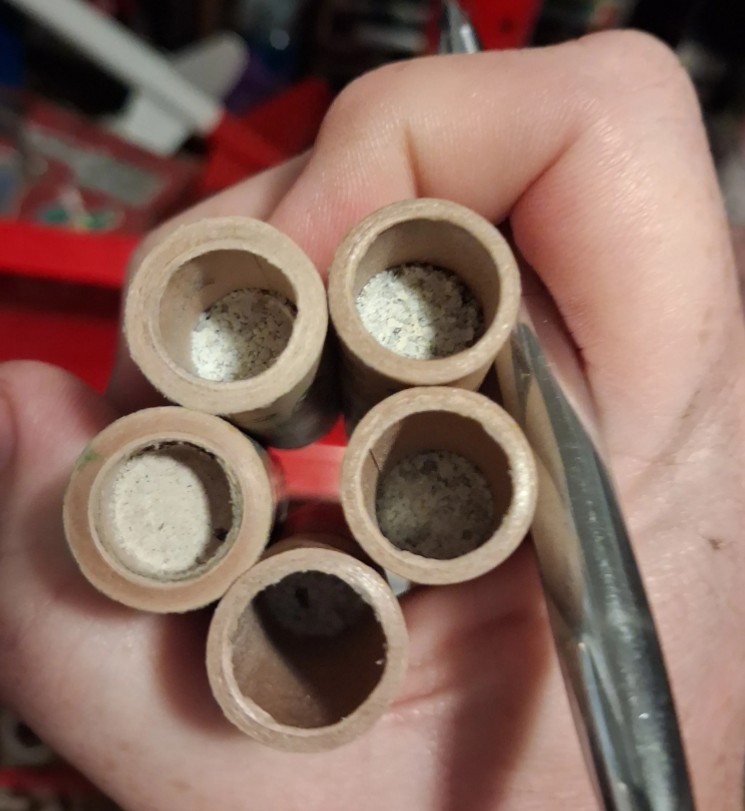

Quote from Admin on August 12, 2026, 7:43 amQuote from Eric Becher on August 11, 2026, 11:08 pmSome of us may be aware that Estes recently changed the engine tube size of their A, B, C engines. The outside diameter is unchanged, but the inside diameter of the casing is larger. In other words, the casing walls are slightly thinner. See below picture for a comparison.
There is some discussion on The Rocketry Forum (TRF) about this, mostly regarding the affects of the change on peak thrust, total thrust, and duration. I haven't delved too much into this, however there has been an observation that could affect us at our launches.
Now they look like Quest's motors which do have a thinner wall.
I briefly perused that thread and saw that photo. It looks like the paper may be, as someone noted, resin coated. That should make the walls stronger. However, that's not typically a failure point in most of the Estes CATOs. They seem to blow out along their long axis, mainly forward, and not laterally.
According to some on TRF, the nozzle has changed slightly as well. It is reportedly slightly shallower than the old one. Some folks there have started reporting problems with the plugs and igniters. Apparently the old plugs supplied are long enough to crush the igniters in the new engines. (Thinner nozzle means shallower hole for the igniter and plug.) This is supposedly leading to ignition failures. Some of the TRF folks have begun using a small piece of tape to hold the igniter, instead of the plugs.
I don't know if I have any of these newer motors, but they are reportedly showing up in Hobby Lobby, and I'm sure other dealers.
I haven't seen any of these motors either, so I can't comment WRT the nozzles.
Centuri's rocket motors used to be shipped with a sheet of peel-and-stick 18mm circles that were used to secure the igniters. I'd wager one could find similar stickies at Staples and other office supply stores/chains, or Hobby Lobby, etc. or, as you pointed out, good old masking tape. I remember, back in the days when Estes motors shipped in the blue tube, that Estes suggested a small ball of recovery wadding be stuffed into the nozzle to retain the ignitor. I don't recall when those plastic plugs began shipping with their motors.
All of this to say, we might all wish to put a roll of tape in your launch box (I use green Frog tape, but any masking tape should be fine). And we should keep an eye out for these new casings. Perhaps it is enough to just be careful with inserting plugs and igniters, and not push them in too firmly.
I've often showed people how to put igniters into BP motors. In fact, there's a thread here in the Forum. The plastic plugs, with new or old nozzles, promote damaging the ignitor or shorting it in the nozzle when the plugs are driven home.
Quote from Eric Becher on August 11, 2026, 11:08 pmSome of us may be aware that Estes recently changed the engine tube size of their A, B, C engines. The outside diameter is unchanged, but the inside diameter of the casing is larger. In other words, the casing walls are slightly thinner. See below picture for a comparison.
There is some discussion on The Rocketry Forum (TRF) about this, mostly regarding the affects of the change on peak thrust, total thrust, and duration. I haven't delved too much into this, however there has been an observation that could affect us at our launches.
Now they look like Quest's motors which do have a thinner wall.
I briefly perused that thread and saw that photo. It looks like the paper may be, as someone noted, resin coated. That should make the walls stronger. However, that's not typically a failure point in most of the Estes CATOs. They seem to blow out along their long axis, mainly forward, and not laterally.
According to some on TRF, the nozzle has changed slightly as well. It is reportedly slightly shallower than the old one. Some folks there have started reporting problems with the plugs and igniters. Apparently the old plugs supplied are long enough to crush the igniters in the new engines. (Thinner nozzle means shallower hole for the igniter and plug.) This is supposedly leading to ignition failures. Some of the TRF folks have begun using a small piece of tape to hold the igniter, instead of the plugs.
I don't know if I have any of these newer motors, but they are reportedly showing up in Hobby Lobby, and I'm sure other dealers.
I haven't seen any of these motors either, so I can't comment WRT the nozzles.
Centuri's rocket motors used to be shipped with a sheet of peel-and-stick 18mm circles that were used to secure the igniters. I'd wager one could find similar stickies at Staples and other office supply stores/chains, or Hobby Lobby, etc. or, as you pointed out, good old masking tape. I remember, back in the days when Estes motors shipped in the blue tube, that Estes suggested a small ball of recovery wadding be stuffed into the nozzle to retain the ignitor. I don't recall when those plastic plugs began shipping with their motors.
All of this to say, we might all wish to put a roll of tape in your launch box (I use green Frog tape, but any masking tape should be fine). And we should keep an eye out for these new casings. Perhaps it is enough to just be careful with inserting plugs and igniters, and not push them in too firmly.
I've often showed people how to put igniters into BP motors. In fact, there's a thread here in the Forum. The plastic plugs, with new or old nozzles, promote damaging the ignitor or shorting it in the nozzle when the plugs are driven home.